
Types of Glass Door Lock Mechanisms
Keyed Cylinder Locks
One snapped key in a cylinder can lock a business out for hours. The keyed cylinder lock is a common choice among security glass door locks in South Africa, yet its function is often misunderstood. It uses a metal cylinder and a notched key to rotate a cam or bolt. The mechanism relies on precise pin alignment to allow that rotation.
Several variations exist within this category:
- Mortise cylinders sit inside the door frame and resist forced entry better.
- Rim cylinders mount on the door surface and are easier to retrofit.
- Euro-profile cylinders offer higher pick resistance for high-risk areas.
Each type changes how the key interacts with the locking bolt. A common issue is cylinder drag over time, especially in coastal areas where salt and humidity corrode the pins. For many South African businesses, the keyed cylinder remains a cost-effective choice. The trade-off is key control. Lost or copied keys can weaken even the best security glass door locks.
Mortise Locks
Mortise locks hide their working parts inside the door frame. The lock body fits into a recess cut into the aluminium or steel edge, rather than sitting on the surface. That recessed position makes security glass door locks more resistant to simple prying attacks, which is why many South African shopfronts use them.
Installation demands precision. If the recess is cut too deep or too shallow, the bolt may not seat properly into the strike plate. A poorly fitted mortise lock develops a slight wobble, and the handle feels loose over time.
When fitted correctly, this mechanism offers:
- A flush finish that does not catch on clothing or bags
- Stable alignment between bolt and strike plate
- Consistent performance in high-traffic entrances
The trade-off is that repair work usually requires removing the entire lock body from the frame.
Electronic Keypad Locks
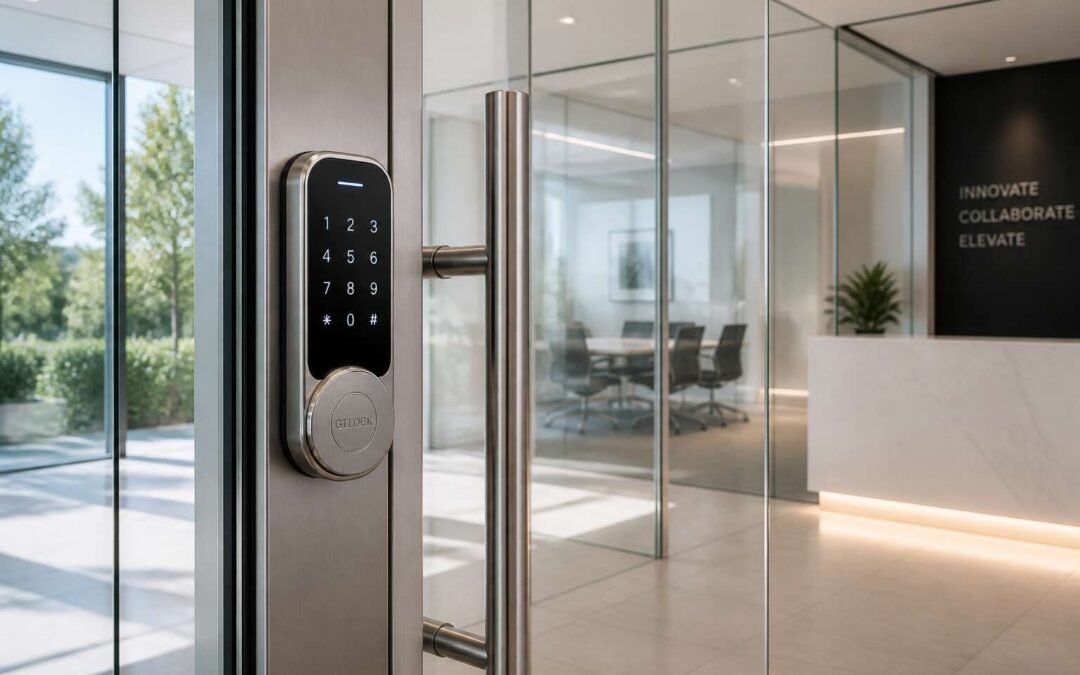
Electronic keypad locks trade mechanical complexity for programmable convenience. They mount on the frame or use a reader plate adhered to the glass. For shops that rely on security glass door locks, the keypad’s appeal is the removal of physical keys entirely. Once staff turnover happens, you simply reset the code!
I find the real benefit is auditability. Many keypads log entry times, giving managers a reliable entry log of who came and went. Common mounting options include:
- Surface mounted readers on aluminium frames
- Thin keypads bonded to the glass pane
- In-frame units that replace the lock body
Some models integrate with alarm systems, while others accept a physical key override for power failures.
Smart Locks with Biometric Access
In the quiet hours, a fingerprint becomes a key that cannot be lost or copied. Biometric access systems read the whorls of a fingertip, granting entry only to those whose flesh bears the mark. For businesses relying on security glass door locks, this removes the vulnerability of stolen codes or forgotten fobs. The glass itself remains cold, but the lock recognises warmth.
Consider the mounting realities in South African storefronts:
Fingerprint readers bonded to glass with optical sensors
Recessed biometric units that replace the handle set
Hybrid models pairing a card swipe with a live scan
These mechanisms store templates locally, not in the cloud, which matters when connectivity falters. A thief cannot pick a biometric lock, though they may attempt to lift a print. The technology feels almost ancestral, a return to the body as proof of identity. For high-traffic doors, these security glass door locks endure thousands of scans daily without wearing out.
Critical Security Features to Evaluate
Material Strength and Durability
The South African Police Service reports that over half of forced entries target door hardware, not the glass pane itself. That is why material strength determines whether security glass door locks survive a crowbar or a shoulder slam. I have tested locks that looked solid but used zinc alloy castings, which fracture under cold temperatures common in Cape Town winters.
Durability demands attention to galvanic corrosion between the lock body and the aluminium frame. Without proper isolation, electrolysis eats away the mounting screws within eighteen months. A hardened steel bolt rated at 700 Newtons resists prying. The strike plate remains the weakest element. Reinforced plates with deeper screws into the frame make the entire assembly sturdier. The true test emerges after years of coastal humidity, when lesser metals fail.
Pick Resistance and Bump Proofing
Pick resistance begins with pin chambers manufactured to tolerances measured in thousandths of a millimetre. A sloppy cylinder yields to a rake in seconds. I have watched a determined intruder defeat a cheap lock with a bent paperclip and patience. The security glass door locks that survive such attention use spool pins and serrated drivers, elements that turn a simple push into a series of false sets.
Bump proofing demands a different defence. The bump key technique relies on kinetic energy transferring to every pin simultaneously. Shields, such as telescopic pins or magnetic actuators, absorb that shock. Some cylinders incorporate a secondary locking bar that engages only when the plug receives sudden impact. These mechanisms separate genuine security glass door locks from decorative hardware.
Consider these features:
- Number of pins, ideally six or more
- Presence of anti-bump springs
- Drilled and hardened plug
Each element adds delay. Every extra minute at the door increases the chance of discovery.
Tamper-Proof Hardware and Screws
Every lock has a weakness. The cylinder may laugh at picks, the pins may refuse to bump, yet one exposed screw invites a more direct form of persuasion. The intruder does not pick the lock. He removes it from the door.
Tamper proof hardware is the barrier between appearance and function. Security glass door locks depend on the integrity of their anchors. Consider what secures the plate to the frame:
– One way screws that resist removal
– Breakaway heads that shear under torque
– Case hardened pins that dull drill bits
Each element forces the attacker to change tactics and spend time. In South Africa, forced entry against the frame remains common. I have watched a screwdriver twist clean through a mild steel screw. The screws are the quiet witnesses of every break in. Security glass door locks without hardened hardware promise little more than a delay measured in moments.
Integration with Glass Break Sensors
The true measure of a barrier is not what it withholds, but what it reveals. A lock may hold firm, yet the glass beside it can betray the entire perimeter. The integration with glass break sensors transforms a passive defense into an active warrant of vigilance, a silent witness to the violence of entry. An intruder does not always pick the lock, he shatters the pane to reach the latch. Without a sensor, the security glass door locks become a silent accomplice to the breach, their mechanisms intact while their purpose is undone.
The sound of fractured crystal is a language of its own. The sensor must discern this dialect from the ambient noise of a township night, a storm, or a passing truck. It listens for the specific frequency of a forced entry. When the glass yields, the signal races to the alarm, and the security glass door locks become part of a larger network of alarm. This is not a matter of convenience, but of consequence. A door that cannot speak is merely a wall with a handle.
Consider the placement of these devices, specifically the distance from the glass and the sensitivity of the microphone. An improperly calibrated sensor is worse than none at all.
– It must cover the full expanse of the glass pane without blind spots.
– It must reject the low frequency thrum of traffic or distant thunder.
– It must trigger before the intruder can reach through the broken frame to disengage the lock.
I have stood in the ruins of a shattered storefront, the dust still settling, and wondered how long the alarm had screamed into the empty street. These details, when ignored, turn a silent witness into a deaf one. The integration must be seamless, ensuring the security glass door locks are not the only line of defense, but the last one to fail. The sensor is the memory of the glass, and it must never forget the sound of its own breaking, for that sound is the obituary of a secure place. The silence after the shatter is the true horror.
Key Control and Restricted Keyways
Key control determines who holds the means of entry. I have seen key systems fail for one reason: too many copies. A cylinder that cannot be duplicated protects more than a master key that circulates freely. In this country, the copy machine at the local hardware store has undone more security than any crowbar. Restricted keyways demand authorization to reproduce. The key blank is patented; the locksmith cannot cut it without the owner’s credentials. For security glass door locks, this matters. A lock body may resist brute force, but if a stranger holds the key, forcing the door becomes unnecessary.
What defines a restricted system?
- Registrable keys with unique card identification.
- Keyways that require a security code for duplication.
- A lockout list for dismissed employees.
Without these, the lock cannot be trusted. The lock protects the room; key control protects the lock. For security glass door locks, the difference is whether the door opens for you or anyone.
ANSI/BHMA Security Ratings
ANSI/BHMA ratings rarely appear in glossy brochures, yet they carry more weight than any feature list. These standards measure performance under controlled conditions. Grade 1 hardware survived one million operational cycles. Grade 2 held for 500,000. Grade 3 lasted 250,000. For security glass door locks, that number predicts how long the mechanism will stay functional under real world demands.
The tests go further. Latch strength, impact resistance, and corrosion under salt spray all factor into the final grade. A lock that looks identical to a Grade 1 model may be graded lower once its internal components are examined. When you compare security glass door locks, check for the ANSI/BHMA certification mark and the grade itself.
Consider these elements when reviewing a rating:
- Operational cycle counts for daily use
- Lateral and impact force thresholds
- Environmental endurance for weather exposure
Grade 3 hardware suits low traffic residential spaces. A commercial entryway demands Grade 1. The rating is the difference between a lock that fails quietly and one that holds.
Installation Considerations for Glass Doors
Professional vs. DIY Installation
Consider this: a failure in alignment can render any security glass door lock useless, regardless of its brand. In our experience, South African homes with coastal humidity demand extra care during installation, as minor gaps invite both draughts and prying tools.
Professional installation ensures the lock’s strike plate sits flush with the aluminium frame. DIY attempts often struggle with tempered glass, which cracks under uneven pressure. If you choose to proceed yourself, use a template and check the frame with a level.
- Check the glass thickness before ordering
- Verify the frame’s squareness
- Use anti-corrosion screws for coastal areas
We have seen many DIY installations loosen within months because the screws were overtightened. Professionals also know how to conceal wiring for electronic options. Weight that against the cost of a callout.
Compatibility with Glass Thickness and Framing
There is a quiet finality to the moment a drill bit meets tempered glass. It is not a process that forgives a trembling hand or a careless calculation. The success of your security glass door locks depends on a conversation between the glass and the frame, a dialogue that begins long before the first screw is turned.
The thickness of your glass dictates the depth of the strike plate and the length of the screws used to secure it. A lock designed for a 10mm pane will sit awkwardly on a 6mm door, leaving a gap that a screwdriver can exploit with ease. Equally critical is the frame’s squareness. A frame that has twisted or bowed over the years will cause the deadbolt to miss its keeper entirely.
– Measure the glass thickness before ordering the lock.
– Verify the frame is level and square.
– Check for corrosion on aluminium frames in coastal homes.
We recall a job in Umhlanga where a beautiful glass door was fitted with an over-engineered lock that never seated correctly. The frame was out by a few millimetres. The result was a lock that rattled in the wind and offered no real protection. The right security glass door locks only perform their duty when they are paired with the correct glass and framing. Do not overlook the hinge side either, as the weight of the glass can pull a door out of true over time.
Aligning the Lock with Door Frame Reinforcement
Most break-ins in South Africa do not start with lock picking. They start with a few millimetres of play between the bolt and the frame. Aligning the lock requires more than matching screw holes; the frame’s internal reinforcement must line up with the strike plate.
Glass doors sit in aluminium frames with hollow chambers. If the bolts land in empty space, the lock becomes a cosmetic feature. For security glass door locks to hold, the strike plate must anchor into solid material, not thin cladding.
The failures appear in predictable places:
- Hollow frame channels with no purchase for screws.
- Deadbolts that scrape the keeper because the door has settled.
- Aluminium skins that flex under pressure.
We once repaired a Durban door where the installer had screwed into the aluminium skin. The lock looked correct from outside, yet a shoulder push opened it. Frame reinforcement determines whether the installation survives contact.
Maintenance and Upkeep Best Practices
Lubrication and Cleaning Schedules
Every security glass door lock has a personality. Ignore it, and it will turn on you. A lock that groans at 2 AM isn’t haunted; it’s neglected. The truth is simpler and more sinister. Dirt and dried lubricant kill more locks than any burglar ever will.
Set a cleaning rhythm. Wipe the exterior and interior surfaces monthly with a microfibre cloth. Remove dust from the keyway using compressed air. For electronic pads, use a slightly damp cloth, never a spray.
Lubricate twice a year, ideally before winter and after summer. Use a PTFE-based lubricant, not oil. Oil collects grime and hardens into paste.
- Clean the keyway and strike plate quarterly
- Inspect screws and hinges for loosening
- Test the latch alignment on security glass door locks after any cleaning
This regimen keeps the mechanism honest. A silent lock is a faithful one.
Checking Alignment and Tightening Screws
Follow the screws. Their condition reveals the true nature of security glass door locks. A lock that sits askew will bind and wear unevenly. The screw heads develop rust rings or metal smears when things shift. In Durban’s humid air, this happens faster than you expect.
Check the alignment after any notable temperature swing or after a slammed door. A simple test: close the door slowly and watch the latch enter the strike plate. It should travel without hesitation. If it drags, the frame has moved. I have seen locks fail because of a single loose screw.
Tighten screws in a deliberate order.
- Loosen each screw half a turn, then snug them back in a star pattern.
- Test the handle action after each screw.
- Mark screws that keep turning; they need larger anchors.
An aligned lock is a quiet lock. Security glass door locks reward this attention. A quiet lock is a trustworthy companion.
Updating Batteries and Firmware for Smart Locks
Most smart lock failures trace back to dead batteries. Smart locks on security glass door locks draw power constantly. A dying battery announces itself through hesitation. The latch stutters. The motor whines. In South Africa, load shedding makes battery monitoring a ritual. I check voltage every season. Replace cells with lithium options that handle heat better.
Firmware updates matter equally. Manufacturers release patches that refine motor timing and encryption. Connect the lock to the app and update when prompted. A neglected update leaves your security glass door locks vulnerable to known exploits. Some brands require manual downloads.
Here is a rhythm I follow:
– Test battery levels on the first Sunday of each month
– Update firmware only when the lock is at full charge
– Keep spare batteries in a dry place
This attention turns maintenance into a quiet habit. The lock answers with steady motion.
Addressing Common Security Weaknesses
Vulnerable Exposed Screws
Exposed screws remain a common weakness. On security glass door locks, these small components often become the weakest link, even when the cylinder and strike plate are solid. An attacker with a screwdriver can remove the lock housing in under a minute, bypassing the entire mechanism. The surrounding aluminium or steel frame does little to help; the glass itself offers no anchor point.
The exterior face of a glass door offers little hiding space, so screws are frequently placed where they are visible. Some installers counterbore the screws or use break-off heads that snap flush after tightening. Others seal the fastener heads with a ceramic-based adhesive that must be drilled out, creating noise and consuming time.
Common weak points in security glass door locks include:
- Screws accessible without removing a cover plate
- Fasteners that allow the lock to be lifted off the glass
- Threads secured only by friction
Inadequate Strike Plate Reinforcement
The weak point of most security glass door locks is not the key cylinder. It is the strike plate, the small metal slot that receives the bolt. On a glass door, that plate usually sits on a slim aluminium frame. A bar placed at the locking edge can flex the frame by just a few millimetres, allowing the bolt to slide out of its pocket. That tiny movement is enough to defeat the entire assembly.
The strike plate must be tied to the structure of the frame, not just its outer surface. The glass frame is a hollow rail, and a simple screw into that skin has very little grip.
A sturdier setup involves:
- Longer screws that reach into the interior core of the aluminium rail.
- A back plate that wraps around the frame edge to spread the load.
- Anchor blocks that connect the frame to the masonry opening.
These details keep the frame from shifting under pressure. When that happens, the lock is allowed to perform its actual job.
Lock Bypass Through Glass Breakage
The question is not whether the glass will break, but what happens in the seconds after it does. Many thieves in South Africa carry a centre punch, a tool smaller than a pencil, which can shatter a pane of tempered glass instantly. The resulting hole is silent and large enough for a hand to reach through. This is where the engineering of the lock mechanism becomes a matter of last defence.
A common error is assuming a laminated pane is the only protection needed. While laminated glass holds together upon impact, the aluminium frame around it does not. The real vulnerability is the distance between the glass and the locking bolt. Attackers use a tool to pop the bead, peel the rubber gasket, and remove the broken shards. They then reach for the internal handle or the lock’s backplate.
For security glass door locks to be effective against this specific bypass, the internal components must be shielded. The connection between the lock body and the door frame is the primary battlefield. A retrofit plate on the interior surface, made of hardened steel, prevents an attacker from simply unscrewing the mechanism from the outside. The strike box must also be protected, so a tool cannot pry the bolt back through the gap.
The effective systems utilise a multi point lock that secures the door at multiple positions along the frame, not just at the centre handle. This spreads the force of any deflection attempt.
– The top and bottom hooks engage deep into the frame.
– The central deadbolt remains independent of the handle.
– All moving parts are shielded behind a steel cover plate.
The frame extrusion must also be deep enough to house these components without creating a weak seam. If the glass breaks and the frame bends, the door should still remain attached to the frame at multiple points. The attacker is then left with a hole in the door, but no way to operate the latch. The lock’s job is to keep the door closed, even if it is no longer transparent. That is the true test of a barrier. The physical security glass door locks must therefore be evaluated on their internal architecture, not merely on the visible keyway or handle.
Key Duplication Risks and Solutions
Key duplication remains a quiet vulnerability for many homeowners. The spare key cut at a local hardware store may not be the threat. The real risk lies in uncontrolled access to the original. A domestic worker, a contractor, or a former partner can copy a key in minutes. The lock becomes a ghost of its former self, open to anyone with a memory and a visit to a kiosk.
Many operations in South Africa still rely on standard keyways that any locksmith can replicate without authorization. This is a failure of procedure, not just hardware. The fix involves a shift in how you manage access:
- Track every key issued, including the blanks.
- Use keyways with patent protection so blanks are restricted.
- Recode the cylinder after any personnel change.
For security glass door locks, the key cylinder is the throat. If you cannot control the key, you cannot control the door. The architecture of the lock matters less than who possesses the means to turn it. A high security cylinder with a restricted keyway is not a luxury. It is a gatekeeper for the entire system. The metal frame, the multi point bolts, and the reinforced strike plate all become theatre if a simple key opens the door. Prioritize the key as the first line of defense. The rest of the system only works when the key remains a secret.
Lack of Secondary Locking Points
Most forced entries through glass doors exploit a single lock at the handle. Once that bolt gives, the door opens. Secondary locking points prevent this by engaging at multiple locations. Security glass door locks require these points to resist pry bars and leverage. Without them, the frame flexes while the glass remains intact. In South Africa, this weakness is common.
A door with only a central lock is not secure. It is merely closed. Multi-point mechanisms secure the door at the top, bottom, and middle. They distribute force. The absence of secondary locking points leaves the primary lock alone. That is a critical mistake. Security glass door locks depend on shootbolts and hooks. These components engage the frame directly. They create resistance along the entire height of the door. A single point of failure turns a strong lock into a weak barrier.
Sensor and Alarm Integration Gaps
Even the strongest security glass door locks can fall silent when sensors and alarms are wired as an afterthought. In many South African homes, the lock operates in isolation, while the alarm system watches an entirely different perimeter. That disconnect creates a blind spot.
Common gaps we encounter:
- Contacts mounted on the frame instead of the moving door leaf
- No tamper detection on the sensor wiring itself
- Alarms that trigger only after the door is already open
When the sensor never registers the bolt’s true position, forced entry gives no warning. Security glass door locks need integration that reads the door state, not just the frame state.