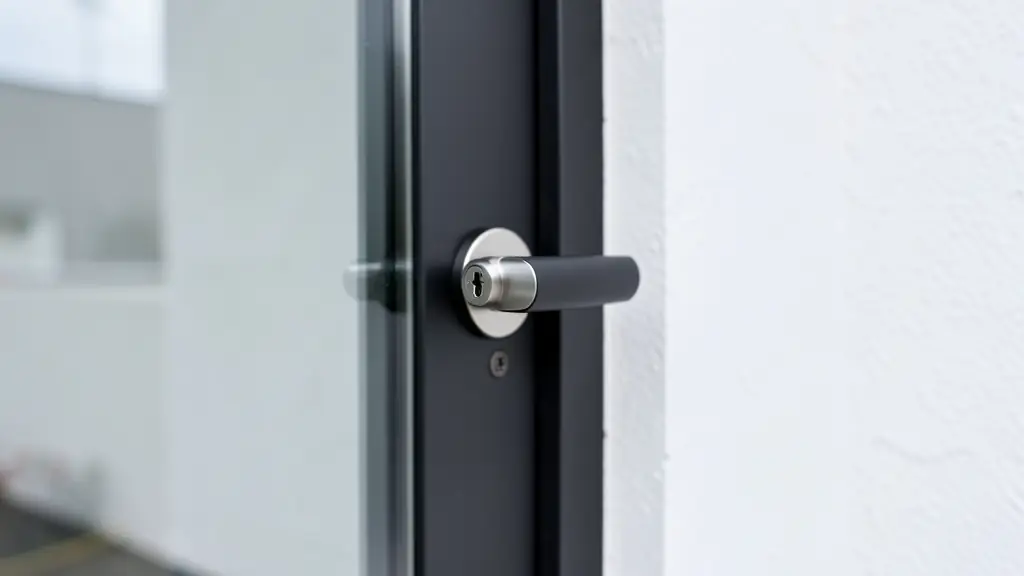
Euro cylinders look the same but come in dozens of lengths. Buy one too long and it sticks out where it can be snapped; too short and the key won't reach. Enter two measurements and the calculator gives the size to ask for at the hardware store or the locksmith.
TL-02How to measure a euro cylinder
- Find the fixing screw on the edge of the door, in the lock's faceplate, in line with the keyhole. It holds the cylinder in place.
- Measure from the centre of that screw to the outside face of the outside handle plate or escutcheon. That is A.
- Measure from the centre of the screw to the outside face of the inside handle plate or thumbturn rose. That is B.
- If the old cylinder is out, measure it from the centre of the screw hole in the body to each end instead.
Sizes are written outside first, then inside: a 35/45 is 35 mm to the outside and 45 mm to the inside, 80 mm overall. Cylinders are made in 5 mm steps, so pick the size nearest your measurement that doesn't stick out more than about 3 mm on the outside.
Common cylinder sizes
Overall lengths and the splits you are most likely to find on the shelf. Offset sizes such as 30/40 are made for doors with a thicker plate on one side.
| Overall | Common splits | Usually fits |
|---|---|---|
| 60 mm | 30/30 | Doors with thin handle plates, many interior doors |
| 65 mm | 30/35, 32.5/32.5 | Slightly thicker doors or plates |
| 70 mm | 35/35, 30/40 | A common size for timber front doors |
| 75 mm | 35/40, 30/45 | Thicker doors, or a thick plate on one side |
| 80 mm | 40/40, 35/45 | Solid doors with security handles |
| 85 to 100 mm | 40/45, 45/45, 45/50 and up | Thick or composite doors and long offsets |
A euro cylinder costs about R155 to R390 at South African hardware stores for 60 to 70 mm double cylinders; anti-snap and high-security cylinders cost more. See cylinder locks.
Why the size matters for security
A cylinder that sticks out past the handle can be gripped and snapped, which breaks off the outside half and leaves the cam exposed. Keep the outside flush or within about 3 mm of the handle plate, choose an anti-snap cylinder with a sacrificial cut line for outside doors, and fit a security escutcheon if the smallest size still sticks out. A cylinder that is too short on the inside is less of a worry, but the thumbturn or key has to reach the cam.